
Fast Track Summary
- Maintain strict relative humidity control below 60% to stop mold growth without unnecessarily inflating energy costs or overworking compressor components while out of state.
- Configure modern smart or hybrid thermostat-humidistat systems to operate between 78°F and 80°F, balancing latent moisture removal against sensible heat load management.
- Mitigate coastal corrosion and drain line failures by applying marine-grade coil coatings and installing automatic condensate float switches before leaving Collier County for the summer.
- Secure seasonal HVAC service checks to confirm refrigerant charge, verify blower motor performance, and optimize air handler static pressure before shut-in.
The Naples Snowbird AC Checklist: Setting Your System to Prevent Summer Mold
Setting your thermostat to 85°F and shutting off your air conditioner before heading north for the summer is the fastest way to return to a ruined Naples home. In Southwest Florida’s hyper-tropical climate, your cooling system is not a luxury temperature controller; it is your home’s primary mechanical defense against structural mold growth, drywall degradation, and catastrophic indoor humidity. Leaving a coastal estate or condo unattended between May and October without a proper HVAC strategy creates a warm, stagnant incubator where toxic mold spores thrive in as little as 24 to 48 hours.
Balancing indoor air quality with energy efficiency while living out of state requires an understanding of residential thermodynamics. You must manage sensible heat (the temperature on the thermometer) alongside latent heat (moisture suspended in the air). Failing to calibrate your thermostat, humidistat, air handler, and drainage components before your seasonal departure exposes your investment to expensive environmental hazards.
Mastering Dew Point and Humidity Mechanics in Coastal Southwest Florida
Targeting an arbitrary thermostat temperature without addressing relative humidity is a critical error seasonal residents make. Mold spores remain dormant when relative humidity stays below 60%, but they multiply exponentially once indoor humidity crosses 65% for extended periods.
In coastal communities like Naples, Bonita Springs, and Estero, summer ambient dew points frequently exceed 75°F. Outdoor moisture continuously diffuses through exterior building envelopes via unsealed doors, window frames, and building materials. If your air conditioner runs only briefly because the temperature setpoint is too high, the system will cool the air slightly without removing enough moisture.
The moisture removal process moves through distinct thermodynamic phases during every cooling cycle:
- Air Entry Phase: Warm, high-humidity indoor air enters the return ductwork and passes directly across the cold evaporator coil.
- Sensible Cooling Phase: The refrigerant inside the evaporator coil absorbs heat energy from the air, causing the measured indoor air temperature to drop rapidly.
- Dew Point Threshold Phase: As the air temperature reaches its dew point, moisture transitions from a vapor into liquid condensation on the coil fins.
- Latent Heat Removal Phase: Condensate trickles down into the drain pan while fully conditioned, dehumidified air circulates back into the home.
To achieve effective dehumidification, air must remain in contact with the evaporator coil long enough for moisture to condense into liquid water and drain away. Standard single-stage systems running short cooling cycles drop indoor temperatures rapidly without pulling sufficient moisture from the air. This dynamic lowers room temperature while relative humidity climbs, bringing indoor surface temperatures close to the dew point and creating ideal conditions for mold growth on drywall, leather, and wood surfaces.
For homes equipped with variable-speed compressor technology or dedicated indoor air quality solutions, managing latent moisture loads becomes far more precise. Inverter-driven systems dynamically throttle down their operating frequency, running for extended periods at lower capacity. This continuous, low-speed operation keeps evaporator coil temperatures below the dew point, pulling gallons of water out of the air daily without overcooling your home.
Optimizing Smart Thermostats and Humidistats for Seasonal Absences
Choosing between a standard digital thermostat, a dedicated humidistat, or a connected smart thermostat impacts how your system handles moisture while you are away.
- Dedicated Humidistat Configurations: Legacy systems often pair a standard thermostat with a wall-mounted humidistat wired in series. In this setup, set the thermostat to 78°F and the humidistat to 55% relative humidity. The air conditioner will run whenever either the indoor temperature exceeds 78°F or the relative humidity exceeds 55%, preventing humidity spikes even if indoor air temperatures remain moderate.
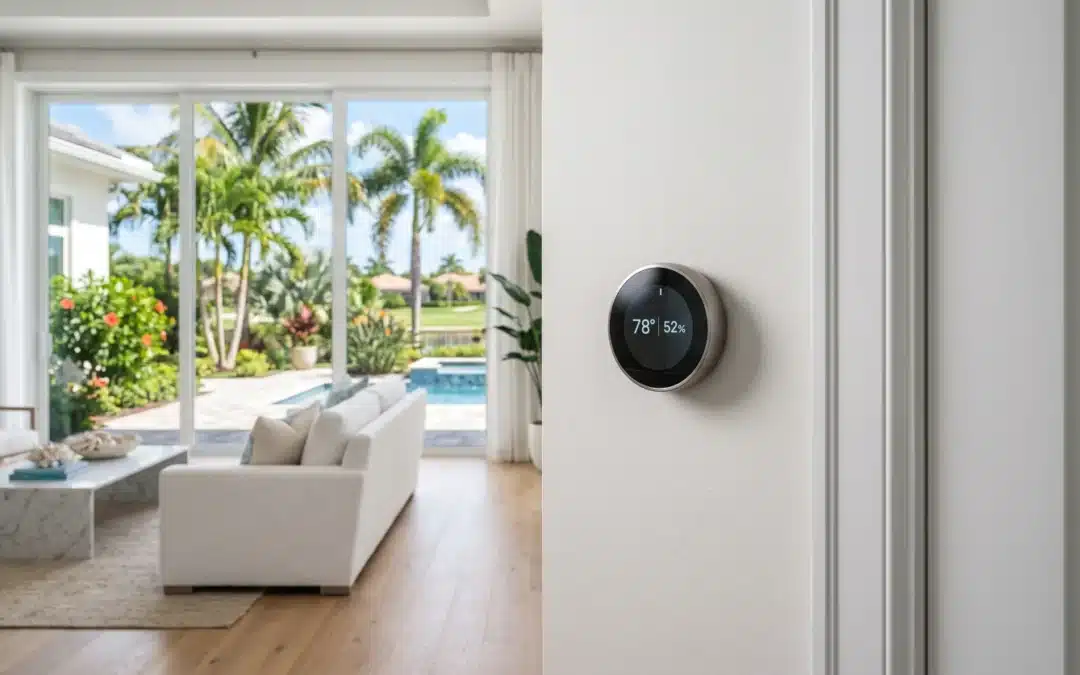
- Smart Thermostat Programming: Systems like Nest, Ecobee, or Honeywell Home allow remote monitoring of Collier County estates from anywhere in the world. Set your smart thermostat to a constant 78°F to 80°F range while enabling features like “AC Overcool to Dehumidify.” This allows the compressor to lower room temperatures up to 3°F below your setpoint if indoor humidity rises above 58%.
- Constant Fan vs. Auto Mode: Never leave your thermostat fan setting on “ON” while away. Leaving the fan running continuously forces the indoor blower motor to blow warm air across a dripping, wet evaporator coil immediately after the compressor cycles off. This re-evaporates collected water back into your home, rapidly driving relative humidity back above 65%. Always verify your fan is set strictly to “AUTO.”
Overcooling an empty home by locking the thermostat at 72°F in July is equally counterproductive. Cold interior surfaces lower the dew point on exterior walls and window glass, pulling outdoor moisture inward through subtle structural leaks. This thermal differential accelerates moisture accumulation behind drywall, setting off unseen mold growth inside wall cavities.
Mitigating Coastal Risks and Preventing Catastrophic Condensate Failures
Southwest Florida presents environmental challenges that standard mainland maintenance protocols do not address. High salt-spray concentration near the Gulf of Mexico accelerates galvanic corrosion on untreated copper tubing and aluminum condenser fins. Over a few seasons, coastal salt air degrades heat-transfer efficiency and leads to micro-refrigerant leaks that disable your cooling system mid-summer.
Applying marine-grade anti-corrosion coatings to outdoor condenser coils shields metal surfaces from salt degradation, preserving heat exchange efficiency while you are away. However, the most immediate physical threat to an unattended summer property is a clogged condensate drain line.
When a primary condensate line blocks during summer, the system follows a predictable and high-risk sequence of events:
- Biological Slime Accumulation: Algae, fungi, and organic matter grow rapidly inside the warm, moist PVC drain trap, creating a complete physical blockage.
- Drain Pan Overflow: Condensation produced by the evaporator coil cannot escape and quickly fills the primary internal drain pan to capacity.
- Safety Switch Trigger: An installed emergency float switch detects the rising water level and immediately cuts power to the outdoor compressor to prevent an overflow.
- Consequences of Protection: While the float switch prevents water damage, the total shutdown leaves the home without active cooling or humidity control, driving indoor moisture levels into mold-growth territory within days.
- Consequences without Protection: If no functional float switch exists, the pan overflows, saturating ceilings, drywall, and hardwood flooring, resulting in catastrophic structural damage.
During heavy summer operation, a high-efficiency air handler pulls up to 20 gallons of moisture from indoor air daily. This warm water flows through a PVC drain line, creating an ideal environment for biological slime and algae growth. Without preventative treatment, algae blocks the drain trap, backing water up into the indoor air handler pan.
If your primary line lacks an operational secondary safety float switch, overflowing condensate will spill into your ceiling, walls, and flooring, causing thousands of dollars in water damage. If your unit does have a float switch (as required by current Florida Building Code), the switch trips and safely shuts down the cooling system to prevent flooding. However, if you are out of state, your home now sits without cooling or dehumidification during peak summer heat.
Pairing a float switch with an automated smart home monitoring sensor alerts you or your local home watch team the moment a shutoff occurs.
To ensure long-term reliability and proper airflow balance across every room in your home, consult the certified technical specialists at Wicked Cool AC for a comprehensive pre-departure inspection.
Strategic HVAC Engineering and Long-Term Protection Measures
Setting thermostat parameters is only one part of protecting a vacant home. Maintaining performance across long summer absences requires addressing static pressure, whole-home air distribution, and proper filtration mechanics.
Ductwork Static Pressure and Air Balancing Dynamics
An unbalanced duct system creates hot spots and stagnant zones where air fails to circulate, causing isolated humidity pockets even when the main living area stays at 78°F. High static pressure caused by crushed flex ducting, improperly sized returns, or clogged filters strains the blower motor and reduces overall latent heat removal.
Proper air filter selection plays a central role in maintaining systemic balance while away:
- MERV 8 to MERV 11 Filters (Optimal Choice): These filters provide ideal particle filtration without introducing excess resistance to airflow. Static pressure remains within factory parameters, ensuring maximum latent moisture removal across the evaporator coil.
- MERV 13 and Higher Filters (Restrictive Choice): Ultra-dense filtration media restricts overall system cubic feet per minute (CFM) airflow. In humid climates, reduced airflow can drop evaporator coil temperatures below freezing, causing ice build-up, compressor damage, and complete cooling failure.
- Before departure, install a fresh media filter rated between MERV 8 and MERV 11. Keep supply vents completely open across all rooms; closing interior doors or supply registers alters system static pressure, reducing overall efficiency and promoting stagnant humidity traps.
For complex floor plans or luxury homes, custom air balancing and airflow optimization ensures balanced static pressure and consistent moisture removal across every zone while you are away.
Modern Refrigerants, Inverter Compressors, and System Upgrades
Older cooling systems operating on R-410A refrigerant are increasingly expensive to service due to environmental phase-downs aimed at lowering global warming potential (GWP). Modern replacement systems utilize low-GWP A2L refrigerants, engineered to operate alongside high-efficiency inverter-driven variable-speed compressors.
Comparing standard single-stage cooling against variable-speed technology highlights why modern systems protect seasonal properties far more effectively:
- Compressor Capacity Control: Single-stage systems operate strictly at 100% capacity or turn off completely, whereas variable-speed inverter systems dynamically adjust output between 25% and 100% depending on real-time load demands.
- Dehumidification Efficiency: Single-stage units perform moderate dehumidification because short cooling cycles shut off the system before moisture fully drops off the coil. Inverter systems run continuous, low-speed cycles that extract moisture constantly.
- Energy Consumption Dynamics: Single-stage units draw high electrical inrush current during frequent stop-and-start cycles. Inverter units run at ultra-low wattages for extended periods, reducing overall power consumption as validated by U.S. Department of Energy efficiency standards.
- Indoor Relative Humidity Stability: Single-stage equipment causes humidity to fluctuate across a wide band (+/- 8% RH), whereas inverter equipment maintains precise relative humidity target ranges (+/- 2% RH).
If your home’s cooling system is over ten years old and uses single-stage technology, reviewing your system’s efficiency profile and checking current AC replacement and unit cost options can help prevent an unexpected mechanical failure while you are out of state.
Pre-Departure Checklist for Seasonal Residents
Work through this essential mechanical checklist before locking your doors for the summer season:
- Thermostat Calibration: Confirm thermostat is set to 78°F–80°F, fan mode set to AUTO, and overcool dehumidification options are activated.
- Drain Line Sanitize: Pour one cup of white vinegar down the primary condensate drain access port to clear early algae accumulation.
- Filter Replacement: Replace existing return air filters with fresh MERV 8 to MERV 11 pleated media filters.
- Float Switch Testing: Manually lift or test the emergency condensate float switch to ensure it cuts power to the compressor when tripped.
- Clear Outdoor Footprint: Trim shrubs, palms, and vegetation back at least 24 to 36 inches around the outdoor condenser unit to maintain clear airflow.
- Power & Surge Protection: Install a dedicated compressor surge protector to shield sensitive inverter control boards from frequent Southwest Florida summer lightning strikes.
- Home Watch Coordination: Provide your local home watch team or property manager with instructions on checking condensate drain lines and inspecting for smart system alerts.
For complete coverage and peace of mind while away, book a comprehensive preventive HVAC maintenance service to inspect electrical contactors, verify refrigerant subcooling/superheat, and flush the drainage infrastructure before you travel north.
Key Takeaways
- Target Humidity First: Set your indoor environment to maintain relative humidity strictly below 60% using smart overcool modes or humidistat integration set to 55% RH.
- Never Leave the Fan Running: Keep the thermostat fan mode set to AUTO. Running the fan continuously in “ON” mode reintroduces water from the damp evaporator coil back into your living spaces.
- Set Temperatures Between 78°F and 80°F: Avoid setting thermostats above 80°F (which creates mold-friendly warm spots) or below 74°F (which can cause exterior wall condensation).
- Protect the Condensate Line: Clear condensate lines and test primary float safety switches to prevent structural water damage or unexpected system shutoffs while out of state.
- Maintain Free Airflow: Use clean MERV 8 to MERV 11 filters and leave all interior supply registers open to prevent static pressure imbalances across zones.
Secure Your Southwest Florida Home with Wicked Cool AC
Leaving your luxury estate, condo, or commercial space for the summer season shouldn’t mean worrying about high humidity, system failures, or costly mold damage. At Wicked Cool AC, our certified specialists deliver comprehensive 24/7 cooling, air distribution, and moisture control solutions tailored to the environmental demands of Naples, Bonita Springs, and Estero. Whether you need an emergency pre-departure diagnostic, a smart thermostat setup, or complete whole-home air balancing, we are here to protect your property year-round.
Protect your home before heading north. Contact Wicked Cool AC today to schedule your pre-summer HVAC maintenance inspection!

